Browsed by
Author: Johann Begel

06/04/2026 – A. Villalonga Gordaliza: Del Trocadéro al Quai Branly: historiografía y arqueometría de los materiales “teotihuacanos”

06/04/2026 – A. Villalonga Gordaliza: Del Trocadéro al Quai Branly: historiografía y arqueometría de los materiales “teotihuacanos”

Dear Member of the Society of Americanists,

We are pleased to announce that the Society’s next conference will be held on Thursday, June 4, 2026, at 6:00 p.m., in Lecture Hall 2 of the Quai Branly Museum.

Annabel Villalonga Gordaliza (Autonomous University of Barcelona – Department of Art and Musicology) will present:

From the Trocadéro to the Quai Branly (MQB-JC): Historiography and Archaeometry of the “Teotihuacan” Materials in the Alphonse L. Pinart Collection.

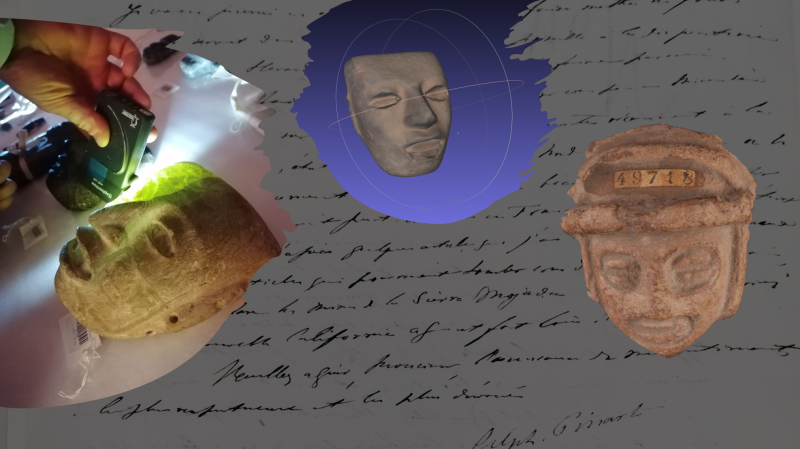
The MQB-JC houses a collection of archaeological artifacts from Teotihuacan, the Valley of Mexico, and other sites in the Mexico Basin that belonged to the collection of French explorer, anthropologist, and linguist Alphonse L. Pinart (1852–1911), who traveled through northern Mexico, the Gulf Coast, and the state of Guerrero between 1878 and 1882. Based on a historiographical and documentary study, the ongoing research examines correspondence, old catalogs, and museum inventory records in order to reconstruct the history of these pieces. The presentation will propose alternative hypotheses regarding the possible methods of acquisition for some of these objects. The second focus of the project centers on the study of eight “Teotihuacan-style” stone masks preserved in the museum’s storage. The presentation will outline the initial results obtained through traceological analyses aimed at identifying tool marks associated with possible modern manufacturing, as well as a geometric morphometric study applied to two specimens. Through the integration of historiographical research and archaeometric analysis, this contribution seeks to offer new perspectives on the formation, circulation, and authenticity of Mesoamerican collections in European museums.

The lecture will be delivered in Spanish

05/21/2026 – D. Tavárez : “From Idolatry to the Republic of Letters: Cosmology and Resistance in Colonial Mexico”

05/21/2026 – D. Tavárez : “From Idolatry to the Republic of Letters: Cosmology and Resistance in Colonial Mexico”

Dear Member of the Society of Americanists:

We are pleased to invite you to the Society of Americanists’ upcoming lecture, which will take place on Thursday, May 21, 2026, at 6:00 p.m. in Room 2 of the Quai Branly Museum.


David Tavárez, professor of anthropology (Vassar College, United States), will present:

From Idolatry to the Republic of Letters: Cosmology and Resistance in Colonial Mexico

In 1702, following the repression of a revolt in a yeche (Zapotec community) in New Spain, the Bishop of Oaxaca offered amnesty to the idolaters in exchange for collective confessions. To avoid any conflict, 68 Zapotec communities denounced their ritual specialists, handing over sacred songs and 102 ritual calendars in the Zapotec language. These texts, composed by specialists using the Latin alphabet, contain cosmological and cosmogonic narratives and ritual protocols that resemble those of ancient pre-Columbian texts. Sent to the Council of the Indies as proof of the failure of the Dominican Order’s evangelization projects, this corpus remained forgotten until the 1960s. This lecture presents these exceptional archives, which, as the largest corpus of indigenous calendars from the colonial Americas, offer a better understanding of Mesoamerican cultural history and its conceptions of the order of time and the cosmos. Drawing on two decades of archival research and fieldwork, this presentation examines the resistance and adaptation of indigenous populations in the face of the colonization of time. This extraordinary corpus demonstrates that, toward the end of the 17th century, indigenous authors briefly established a “republic of letters” that, while deeply rooted in the ancestral understanding of the universe and in Zapotec political interests, also maintained intellectual ties with other bodies of knowledge circulating in the Atlantic world.


The lecture will be given in French.


For your information, the upcoming lectures will take place:

–    On June 4, featuring a presentation by Annabel Villalonga Gordaliza on the MQB’s Pinart Teotihuacan collection.

–    On September 17, featuring a presentation by Stephen Houston titled “Rhythms of Recall: Maya Writing and the Ancestors Beyond Living Memory”

02/19/2026 – M. Orantin : “Les prêches du labeur. Anthropologie historique du travail dans les missions jésuites du Paraguay” 

02/19/2026 – M. Orantin : “Les prêches du labeur. Anthropologie historique du travail dans les missions jésuites du Paraguay” 

Dear member of the Société des américanistes,

We are pleased to invite you to the next conference of the Société des américanistes on Thursday, February 19, 2026, at 6:30 p.m. in the cinema room of the Quai Branly Museum.

Mickaël Orantin, CNRS Research Fellow (ECHELLES Laboratory, UMR 8264), will present and discuss his book with Isabel Yaya-McKenzie (EHESS/LAS):

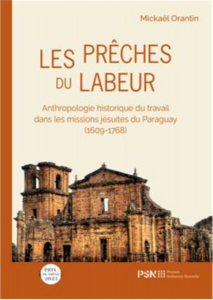
Les prêches du labeur. Anthropologie historique du travail dans les missions jésuites du Paraguay (1609-1768).

Between 1609 and 1768, missionaries from the Society of Jesus founded and administered some thirty large villages in Paraguay, where they evangelized the region’s indigenous peoples, mostly Guaraní. Among the social transformations brought about by conversion to Christianity, those related to work practices and representations played a central role. Missionary production ensured the material sustainability of the villages and, thus, the conditions for evangelization. As an instrument of domination, work also enabled social integration. Its transformations were inextricably linked to those of kinship structures, social assistance, techniques, exchange, identity, and, of course, religion. Through, among other archival documents, the translation and examination of an unpublished monolingual Guarani work catechism written in the missions in the 18th century, this book uses the tools of historical anthropology to uncover the conflicts and collaborations that arose from the encounter between European and Guarani conceptions of work, as well as the misunderstandings that persisted for 150 years.

The lecture will be given in French.

Publication Grant 2026

Publication Grant 2026

CALL 2026

The Publication Grant of the Société des américanistes provides financial support for the publication of books derived from doctoral theses as well as any other scientific book, single-authored monographs or edited volumes. The manuscript must have been accepted by a publishing house, in France or abroad. The publication subsidy covers the disciplines of anthropology, archaeology, history, art history, linguistics, and sociology. It supports original work on societies that identify themselves as indigenous and those that contemporary historiography refers to as Amerindian, Métis, and Afro-Caribbean, considered in their historical context from their origins to the present day. Manuscripts must be written in the one of the main languages of the Société (French, English, Spanish, or Portuguese).

The amount allocated will be capped at €3000 per publication project. The successful applicant has four years to publish their manuscript from the year following receipt of the grant, otherwise the subsidy will be withdrawn.

The deadline for submission is April 30, 2026. Applications will be evaluated by a panel of experts and selected by the Société’s board of Trustees. Results will be announced in the fall of the same year.

The application proposal must consist of:

– The manuscript in pdf format

– The book proposal (approx. 3 pages)

– The author’s CV, including a list of publications

– For manuscripts derived from PhD theses: the Thesis Report or Examiner’s report. In countries where Thesis reports do not exist, please attach detailed letters of recommendation from at least two members of the PhD examination board

– Letter of interest from the publishing house

– Cost estimates from the publishing house (including other financial aids already obtained or solicited and the specific amount solicited from the Société)

– Any other document deemed relevant

Any missing documents will disqualify the application.

Recipients of the Publication Grant commit to mention the Société’s contribution and logo in the book, in accordance with agreements made with the publishing house, which is also expected to give a number of copies free of charge. The successful applicants who are not members of the Société will commit to apply for membership before receiving their grant.

The application package should be sent by e-mail only to: prixaidepublication.sda@gmail.com

2025 General Assembly and conference by E. James Dixon

2025 General Assembly and conference by E. James Dixon

Dear member of the Société des Américanistes,

We are pleased to invite you to the Assemblée générale of the société des Américanistes on Thursday, December 4, 2025, at 6 p.m. in the cinema room of the musée du quai Branly.

This will be followed by a conference of E. James Dixon, Emeritus Professor of Anthropology, University of New Mexico, USA, who will present

How, When, and Why Did Ice Age People First Arrive in North America

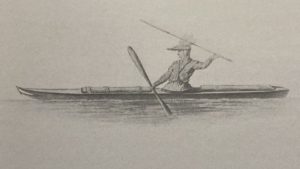
New research from different scientific disciplines converges to indicate that seafaring people were the first to colonize North America. This evidence supports the theory that people using watercraft traveled eastward from Asia by navigating along the islands and southern shore of the Bering Land Bridge and then southward along the Northwest Coast of North America. These first Americans reached the southern regions of the American continents thousands of years before the ice that blocked overland migration southward from the Bering Land Bridge had melted. Seafaring and coastal navigation were developed along Asia’s Pacific coasts by 35,000 years ago. These adaptations made it possible for people to navigate eastward along the southern shores of the Bering Land Bridge to North America circa 17,000 years ago. Recent archeological research along the Northwest Coast of North America supports this hypothesis.

The conference will be held in English.

Call for financial support: organisation of scientific events

Call for financial support: organisation of scientific events

Call 2025-2

The Society is launching its second 2025 campaign to provide financial support for the organization of scientific events related to American studies. These events must correspond to the geographical and thematic areas covered by the Society and its Journal. They must be organized in France in order to be accessible to our members, but may include funding for travel and/or accommodation expenses for participants residing abroad. The Society plans to allocate €2,000 per campaign, spread over two or three projects. Preference will be given to co-financed projects. For this campaign, applications must be submitted before December 1, 2025, for events organized from January 2026 onwards and no later than 18 months later.


The application for financial support must include:

– a cover letter;

– a one-page description of the event in question;

– the program and prospective contributors;

– a detailed budget showing the financial contribution of each partner;

– the CVs of the event organizer(s).


Applications will be selected by the members of the Society’s Board of Directors and foreign correspondents. Beneficiaries also undertake to include the Society’s logo on their promotional materials. Submissions should be sent to the following address:

 aidemanifestations.sda@gmail.com

10/09/2025 – R. Fernandes Mendes Junior: “The Land Without Evil: A Guarani Saga”

10/09/2025 – R. Fernandes Mendes Junior: “The Land Without Evil: A Guarani Saga”

Dear member of the Société des Américanistes,

We are pleased to announce that the society’s next conference will be held on Thursday, October 9, 2025, at 6 p.m. in the cinema room of the Quai Branly Museum.

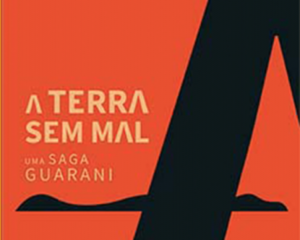
Rafael Fernandes Mendes Junior (Federal University of Rio de Janeiro) will present: The Land Without Evil: A Guarani Saga

After the Chaco War (1932-1935), Guarani groups left the border between Paraguay and Brazil, guided by their shaman, and embarked on a journey of several thousand kilometers to the northern states of Pará and Tocantins. The study of this double migration, which until now had never been the subject of ethnographic investigation, reveals its significance yesterday and today for these groups and their descendants, as well as the social transformations it causes—or results in—, in space and time: the division of the group into smaller units and its dispersion; interethnic encounters and marriages with whites and other indigenous populations; conversion to Christianity and involvement in a movement to affirm their culture; and finally, the transformations of the concept of the individual. The combination of interviews (in Portuguese and Guarani) and historical sources thus allows for a renewed approach to the famous myth of the Land Without Evil, first reported by ethnologist Curt Nimuendaju and then popularized by Hélène and Pierre Clastres.

The lecture will be given in French.

Please go directly to the museum entrance (37 quai Branly), without going through the ticket office. The Vigipirate security plan requires museum security guards to refuse entry to visitors carrying suitcases (even cabin-size), travel bags, backpacks, sports bags, etc.

Publication “Reimaginando el Gran Chaco, Identidades, Política y Medio Ambiente en América del Sur”.

Publication “Reimaginando el Gran Chaco, Identidades, Política y Medio Ambiente en América del Sur”.

We are pleased to announce the publication of the book:

Reimaginando el Gran Chaco, Identidades, Política y Medio Ambiente en América del Sur

Edited by Silvia Hirsch, Paola Canova and Mercedes Biocca.

Published by Editorial Biblos with the support of the Société des Américanistes as part of the 2023 publication grants.
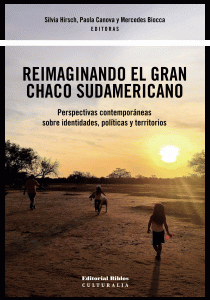
In recent decades, the South American ecoregion of the Gran Chaco has undergone accelerated environmental, social and economic change due to the intensification of extractive industries such as agribusiness, cattle ranching, logging and hydrocarbon exploitation. The region has become a complex arena of political, cultural and economic contestation between different actors, including the state, NGOs and private companies, whose projects and agendas conflict with the livelihoods of local inhabitants. The various chapters explore the dynamics and frictions generated by these changes, and reveal how different local actors experience and negotiate the region’s historical, socio-economic and environmental transformations on their own terms. The book shows how different groups in the Gran Chaco question and redefine their subjectivity, while reconfiguring their political agendas in response to these processes. It also highlights the multiple ways in which peoples inhabiting the vast Chaco region relate to a diverse set of social actors and institutions, even beyond the territorial boundaries of individual nation-states.

ISBN 978-987-814-351-4

376 pages

Coordination

  • Silvia Hirsch

PhD and Master in Anthropology. Bachelor in Anthropological Sciences. Professor and researcher, Escuela Interdisciplinaria de Altos Estudios Sociales, Universidad Nacional de San Martín, Argentina. Author of “ El pueblo tapiete de Argentina : historia y cultura” (2006) and co-editor of “Mujeres indígenas de la Argentina : cultura, trabajo y poder” (2008), “Educación Intercultural Bilingüe en la Argentina” (2010), with Adriana Serrudo ; “Movilizaciones indígenas e identidades en disputa en la Argentina : historias de invisibilización y reemergencia”, with Gastón Gordillo” (2011), and “Salud pública y pueblos indígenas en la Argentina : encuentros, tensiones e interculturalidad”, with Mariana Lorenzett (2016). Her research focuses on gender, ethnicity, borders, health and education among indigenous populations.

  • Paola Canova Cabañas

PhD in Anthropology. Human ecology engineer. Bachelor’s degree in German. Associate Professor, Department of Anthropology, University of Texas, Austin, USA. Author of “Frontier Intimacies: The sexual economy of the Paraguayan Chaco” (2020), translated into Spanish as “Intimidades de frontera: mujeres ayoreo y economía sexual en el Chaco paraguayo” (Biblos, 2023). She has published articles in journals such as the Journal of Latin American and Caribbean Anthropology and the Journal of Mennonite Studies. Her research focuses on gender and sexuality, indigenous urbanity, indigenous-state relations, non-indigenous rurality and the political ecology of the Paraguayan Chaco.

  • Mercedes Biocca

PhD in sociology. Master’s degree in international economic relations. Degree in political science. Currently associate researcher at the Interdisciplinary School of Advanced Social Studies (eidaes), National University of San Martín, Buenos Aires province, Argentina. Author of the book “The Silences of Dispossession, Agrarian Change and Indigenous Politics in Argentina” (2023). She has published in journals such as Tipití. Journal of the Society for the Anthropology of Lowland South America and Población & Sociedad. Her research focuses on rural issues associated with extractivism, and on relations between indigenous populations and the state in contexts of dispossession.
26/06/2025 – E. Katz et A/ Aguilar Meléndez : “Past and present of chillies (Capsicum spp.) in the Americas”

26/06/2025 – E. Katz et A/ Aguilar Meléndez : “Past and present of chillies (Capsicum spp.) in the Americas”

Dear member of the Société des américanistes,

We are pleased to announce that the Society’s next conference will be held on Thursday 26 June 2025, at 6pm in lecture room 2 of the Musée du Quai Branly.

Esther Katz (researcher at the Institut de Recherche pour le Développement, UMR 208 PALOC “Patrimoines locaux, environnement et globalisation” IRD/CNRS/MNHN)

and

Araceli Aguilar Meléndez (teacher-researcher at the Centro de investigaciones tropicales, Universidad Veracruzana Xalapa, Veracruz, México)

will present:

“Past and present of chillies (Capsicum spp.) in the Americas”

The chilli (Capsicum spp.) is more than just a spice in the cultures of the American continent. Its extraordinary diversity in terms of shapes, flavours, aromas and pungency levels is the result of historical processes of management, selection and cultural re-signification that date back millennia. Understanding the biocultural trajectory of chilli requires situating the chilli-culture binomial in specific historical, territorial and social contexts. This paper explores how different American societies have contributed to the domestication, diversification and conservation of this plant, through the maintenance of ritual and food practices. Ethnobotanical data and ethnographic examples illustrating the centrality of chilli will be presented based on fieldwork, mainly in Mexico, and on studies published in the book: Chiles, ajíes y pimentas. Capsicum from the Caribbean, Central and South America (coordinated by Esther Katz, Marco Antonio Vásquez Dávila, Araceli Aguilar Meléndez and Gladys Isabel Manzanero Medina and edited by the Universidad Veracruzana and the IRD).

The conference will be held in Spanish.
Please go directly to the museum entrance (37 quai Branly), without going through the ticket office. The Vigipirate plan requires museum security staff not to allow suitcases (even cabin bags), travel bags, rucksacks, sports bags, etc. to be brought into the museum.

05/07/2025 – C. J. Allen: “Ethnographic Perspectives on Inca Stone Masonry”

05/07/2025 – C. J. Allen: “Ethnographic Perspectives on Inca Stone Masonry”

Dear members, we are pleased to announce that the next conference of the Society will be held on Wednesday, May 7, 2025, from 4:30 to 6:30 p.m. in Salle de Cours 2 at the Musée du Quai Branly.

Catherine J. Allen (Professor Emeritus, Department of Anthropology, George Washington University) will present: Every Stone Is Unique. Ethnographic Perspectives on Inca Stone Masonry

“The wall was stationary, but its lines were seething and its surface changeable, as that of flooding summer rivers” (J. M. Arguedas, Los Ríos Profundos).

Inca stone masonry has long been a cause of wonder and curiosity. Rather than carving out identical blocks of stone and joining them with mortar, Inca masons treated each stone individually, Thus, every stone in a great wall like Hatun Rumiyuq in Cuzco is unique. Each one was lightly finished and then fitted with the others, seamlessly and without mortar, The irregularity of the stones and absence of mortar make the walls resilient in earthquakes, for the stones can move around during the tremor and settle back against each other when the crisis has passed. Moreover, some Inca walls, like those at Sacsahuaman and Ollantaytambo, are composed of truly gigantic monoliths that had to be transported considerable distances from their quarry sites. Research has cast light on how these feats were achieved, yet what was the point of all that time-consuming effort? Grandiose expressions of imperial dominance? Art for art’s sake? Perhaps. But before leaping to conclusions, we need to understand Inca masonry in terms of what Carolyn Dean has termed a “culture of stone.” What ontological assumptions informed the Inca masons’ relationships with their stone medium? I suggest that ethnographic research into contemporary Andean understandings of stone may shed some light on this question.

The conference will be held in english

Please present yourself directly at the museum entrance (37 quai Branly), without going through the cash desks. The Vigipirate plan requires museum security staff not to allow suitcases (even cabin bags), travel bags, backpacks, sports bags, etc. to be brought into the museum.